Our Approach · Travelers Rest, SC
Chiropractic care based on more than where you hurt.
At Foothills Chiropractic, we start with a simple question:
“If the brain and nervous system help coordinate nearly everything your body does, doesn’t it make sense to look at how they’re functioning first?”
Where you hurt matters. But your symptoms are only one part of the picture. They can tell us that something is going on without necessarily telling us why.
That’s why we begin with a detailed evaluation—looking at the brain and nervous system, spine, movement, balance and stress responses—to get a clearer picture of how you’re functioning before deciding what kind of care makes sense.
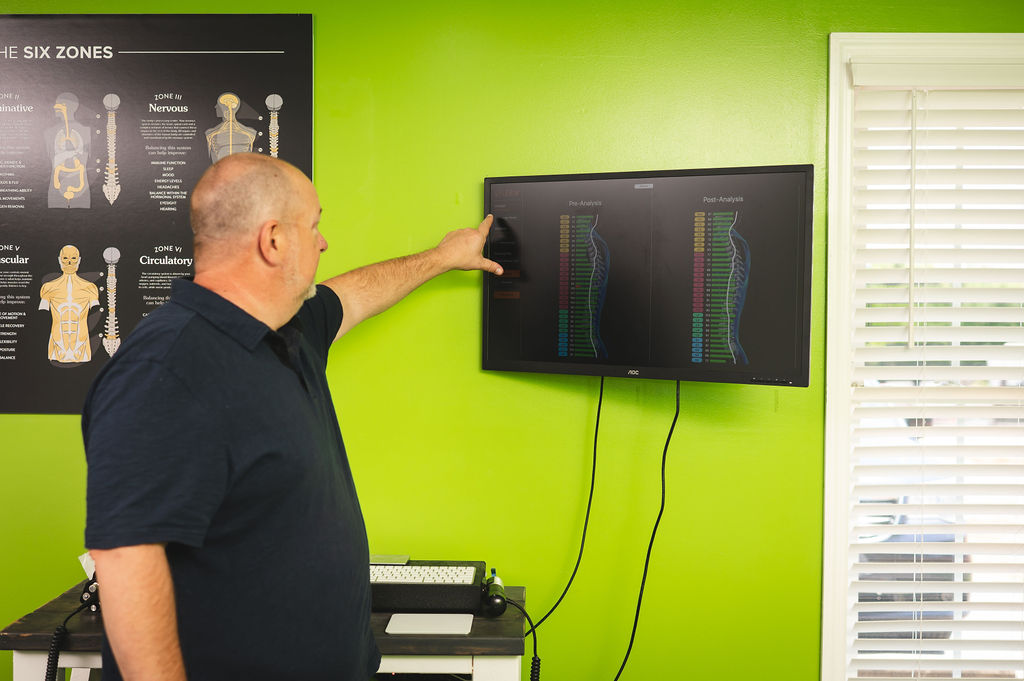
Why we look beyond symptoms
Where you hurt matters. But it isn’t the only thing we want to know.
Symptoms are important — they’re what bring most people through our door, and they’re real. But symptoms alone don’t always tell us enough about how the body is actually functioning. Two people with the same complaint can have very different things going on underneath it.
Before we make any recommendations, we want to understand the bigger picture: how you’re moving, how you’re handling stress, how well your nervous system is regulating, and what your spine and body are actually doing. That understanding is what care is built on.
Evaluate before we treat
The examination should guide the care — not the other way around.
Dr. Geran doesn’t decide ahead of time what adjustment or technique someone needs or how much care they need initially. The evaluation comes first.
What we find determines your care: whether we can help you or not, what we recommend, how often we need to see you, what type of adjustments you will benefit the most from.
Not every patient receives every test. What’s included is based on your history and what is clinically appropriate for you.
What an evaluation may include
- Detailed health history and consultation
- NeuroInfiniti Stress Response Evaluation
- Posture and movement
- Balance and coordination testing
- Palpation and spinal function
- Other examination procedures based on the individual
Not every patient receives every test. Care is individualized.
NeuroInfiniti
How does your brain and nervous system handle stress?
For us, this is the most important question we need to answer for a new patient. How your body responds to stress—and how well it returns toward baseline afterward—tells us a great deal about how your nervous system is functioning.The NeuroInfiniti Stress Response Evaluation measures several physiological responses, including breathing, heart rate, skin temperature, muscle activity and brain-wave activity, while you move through a series of stress and recovery periods.NeuroInfiniti is one part of the overall evaluation, but it gives us objective information we can use alongside the rest of your exam. Because it can be repeated later, it also gives us a way to compare how those responses change over time.
Your care should fit you
Not every patient is adjusted the same way.
Dr. Geran is trained in multiple chiropractic techniques, which gives him flexibility in choosing the type of adjustment, force and approach that best fits the individual.
Your examination findings, age, comfort, history and clinical judgment all help guide that decision.
Techniques Dr. Geran is trained in
Zone Technique
A system that restores function by addressing spinal areas in six functional zones of the body.
LEARN MOREThompson Technique
A chiropractic technique that uses a specialized drop table to assist with comfortable, precise adjustments.
LEARN MOREManual Adjusting
Traditional hands-on chiropractic adjusting using controlled, specific forces.
LEARN MOREArthroStim Instrument Adjusting
A handheld instrument that delivers gentle, rapid, low-force adjustments.
LEARN MOREKoren Specific Technique
A low-force approach using a specific analysis and adjusting protocol.
LEARN MOREMC2 Upper Cervical
A gentle, low-force approach focused on the upper neck.
LEARN MOREExtremity Adjusting
Adjusting joints beyond the spine — shoulders, hips, knees, wrists and more.
LEARN MOREPulstar Computerized Adjusting System
A computerized system Dr. Geran can use to evaluate spinal motion and deliver precise instrument-assisted adjustments.
LEARN MOREProgress is more than “Does it hurt?”
How you feel matters. It isn’t the only measure of change.
Symptoms can improve before function does, and they can linger after function has improved. That’s why Dr. Geran also looks at changes in function and examination findings, and why care may include periodic reassessment rather than relying only on how someone feels on a particular day.
A different kind of chiropractic experience
The philosophy, simply put.
- Evaluate first.
- Understand the individual.
- Let findings guide care.
- Use the appropriate technique and force.
- Reassess progress.
- Decide on the best course of care for maintenance.
Think this approach might be right for you?
Learn how becoming a new patient works and decide whether Foothills Chiropractic feels like the right fit.
What this does — and doesn't — mean
What this does mean
- • We evaluate chiropractic and musculoskeletal function.
- • We look at nervous-system-related functional findings that fall within our scope.
- • We assess movement, balance and coordination findings.
- • We measure stress-response patterns with the NeuroInfiniti evaluation.
- • We make individualized chiropractic care recommendations and re-measure over time.
What this doesn’t mean
- • We do not diagnose, treat or cure diseases.
- • Chiropractic care is not a treatment for dementia, Alzheimer's disease or other neurological diseases.
- • Chiropractic care is not a replacement for medical care, testing or medication.
- • No outcome is promised. Results vary from person to person.
Some symptoms need medical evaluation first. If anything in your history or examination suggests that, we will say so and help point you in the right direction.
Go deeper
Neurologically Based Chiropractic
The brain and nervous system come first — everything else follows from that.
How We Evaluate You
Before anything else, we find out how your system is actually functioning.
NeuroInfiniti
A stress response evaluation that measures how your nervous system reacts and recovers.
Chiropractic Techniques
Multiple methods, from very low-force to more traditional hands-on adjusting.
Measuring Progress
How you feel matters. It is not the only measure of whether things are changing.
Think Foothills Chiropractic might be right for you?
Start Here walks you through what the process looks like, so you can decide whether taking the next step makes sense for you.